Every serious marketplace decision is made with incomplete information.
You know some of what is relevant. You know your financials, your team’s capacity, the intelligence your research has produced, the read you have on the room. You have accumulated judgment through years of experience, and that judgment is real and valuable. But there are always variables you cannot see. The client’s internal politics. The competitor’s next move. The regulatory shift that is eighteen months away from being announced. The partner who is about to leave. The market that looks stable and is not.
Every strategy, every negotiation, every decision to expand or hold or pivot is an exercise in acting on partial information and hoping the invisible variables break in your favour. The most experienced executives in the world will tell you, in honest moments, that a significant portion of what looked like strategic genius in retrospect was simply reading the visible data well and getting fortunate about the things they could not see.
This is the universal condition of marketplace leadership. You are always operating in a fog.
The previous article in this series examined identity in Christ as the foundation from which the believer operates in the marketplace. It closed with this observation: the believer who has not settled the identity question will find that intimacy with God feels performative — a spiritual discipline aimed at earning access rather than an expression of a relationship that already exists. That is precisely where this article begins. Because once identity is settled, intimacy is not something you pursue to obtain God’s approval. It is the natural functioning of a relationship in which you already stand, and it is the most strategically significant resource available to any marketplace professional.
God is not working with incomplete information.
He knows the outcome of the negotiation before you enter the room. He knows which venture will produce and which will drain. He knows the character of the person across the table from you, the hidden agenda in the proposal, the timeline of the disruption that nobody in your industry has seen coming. He knows what is stored in the darkness that the market has not yet priced. He knows the specific works he prepared for you before the foundation of the world — which means he has, already built into the architecture of reality, the assignments you are meant to carry and the outcomes they are meant to produce.
The question is not whether this intelligence exists. The question is whether you are connected to the Source well enough to receive it.
The Infrastructure Problem
There is a failure mode common among high-functioning believers in the marketplace, and it tends to be invisible precisely because it sits alongside genuine competence and genuine faith.
The pattern looks like this. The professional is skilled, disciplined, and genuinely committed to God. They attend church faithfully. They tithe. They pray when they are in trouble. They credit God publicly for their successes. Their faith is real in the sense that they believe everything they affirm. But the relationship with God functions, in operational terms, the way a fire extinguisher functions in an office building — mounted on the wall, clearly visible, genuinely useful in an emergency, and otherwise uninvolved in the daily work of the place.
Intimacy is not that. Intimacy is the infrastructure through which the daily work is resourced, directed, and sustained.
The distinction matters because the person who treats prayer as an emergency resource is the person who is running, between emergencies, entirely on their own intelligence. Their decisions are shaped by their analysis, their experience, their network, and their intuition — all of which are genuinely valuable and all of which are, by definition, limited to what a human being operating in a particular sector at a particular time with a particular history is able to perceive. They have not positioned themselves to receive what cannot be derived from any of those sources.
Daniel prayed three times a day with his windows open toward Jerusalem. This was not a devotional preference. It was a communication infrastructure — a deliberately structured, non-negotiable, daily practice of orienting toward heaven and maintaining the connection through which the intelligence of heaven flowed. The dream interpretation in chapter two did not happen in a vacuum. It happened through a man whose prayer life had been built over years before the crisis arrived, whose relationship with God was close enough and established enough that, when he needed revelation he had no natural means to access, the channel was already open.
You do not build that channel the night before you need it.
“Call to me and I will answer you and tell you great and unsearchable things you do not know.” — Jeremiah 33:3 NIV
The word translated unsearchable — batsuwr in Hebrew — carries the sense of things that are inaccessible by ordinary means, hidden behind barriers that human investigation cannot breach. God is not promising, in this verse, to confirm what you have already figured out. He is promising to disclose things that your research, your analysis, and your experience cannot produce. Things that are, by definition, outside the reach of the market’s intelligence apparatus.
Every professional in every sector is spending significant resources on intelligence — market research, competitive analysis, industry reports, consultants, advisors, trend forecasting. The appetite for better information is insatiable because everyone in the room knows they are operating in a fog. And here is a God who says: call to me and I will tell you things you cannot find by any other means.
Most believers have heard that verse as devotional encouragement. Very few have treated it as a business proposition.
The Friend of God
There is a title given to Abraham in the scriptures that appears in three different books — Isaiah, James, and 2 Chronicles — and carries a lot of weight.
He was called the friend of God.
Friendship, in the ancient world and in any world, is not a formal category. It is not a transactional relationship, not a covenant of mutual obligation, not a hierarchical arrangement. It is a relationship of genuine knowing, genuine disclosure, genuine care for the other’s interests. The friend is the person you tell things to before you act on them. The friend is the person whose counsel you seek because you trust their judgment and their loyalty. The friend is the person you bring into the room before the decision is made.
Abraham’s friendship with God produced a specific, documented example of what that kind of relationship looks like in practice.
In Genesis 18, God is on his way to Sodom. He pauses — the text actually uses this kind of language, as though a decision is being made mid-journey — and asks: shall I hide from Abraham what I am about to do? The reason he gives is revealing: Abraham will become a great and powerful nation, and all nations will be blessed through him. The friendship carries responsibility. Abraham’s assignment is so significant, his covenant role so central, that God does not simply act in the world and leave Abraham to figure it out afterward. He discloses the intelligence before the event.
Shall I hide from Abraham what I am about to do.
This is the texture of intimacy. Not the general awareness that God is sovereign and things will work out. The specific disclosure, in advance, of what is about to happen — because the relationship is close enough that withholding would feel, from God’s own perspective, like a departure from the nature of the friendship.
The apostle John records Jesus making the same framework explicit to his disciples in the upper room. He tells them he no longer calls them servants, because a servant does not know his master’s business. He calls them friends, and the reason he gives is this: everything that he learned from the Father, he has made known to them.
This is the standing offer to the believer who is walking in genuine intimacy. Not information withheld from the servant. The intelligence shared with the friend.
“I no longer call you servants, because a servant does not know his master’s business. Instead, I have called you friends, for everything that I learned from my Father I have made known to you.” — John 15:15 NIV
The marketplace implication is not subtle. The believer who cultivates genuine intimacy with God is not merely a good professional who also prays. They are a person with access to intelligence that the market has no mechanism to produce. The kind of strategic foresight that looks, from the outside, like exceptional judgment. The sense of when to move and when to hold. The reading of a person or a situation that cuts through what is being presented to what is actually true. The foreknowledge, sometimes specific and sometimes impressionistic, of what is coming before it arrives.
These are the outputs of friendship with God. They are not mystical experiences reserved for the spiritually elite. They are the natural fruit of a relationship that is real, maintained, and trusted.
The Peanut and the Prophet
In the late nineteenth century, a man born into American slavery walked into a small laboratory he called his God room and asked God to show him the secrets of the universe.
The answer, he later said, came back immediate and humbling: the universe is too big for you. Ask for something smaller.
He asked about the peanut.
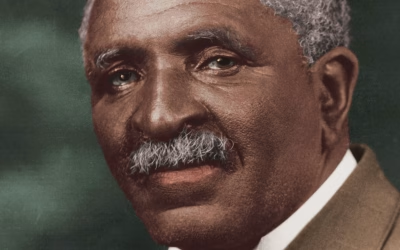
George Washington Carver was, by any measure, one of the most productive scientific minds of his generation. He would go on to develop over three hundred commercial products from the peanut plant alone — cooking oils, dyes, medicines, cosmetics, lubricants, adhesives, and dozens of food products including what would eventually become peanut butter. He performed similar work on the sweet potato and the pecan. His research transformed the agricultural economy of the American South, giving farmers devastated by the boll weevil a crop that could revive their land and their livelihoods.
When asked how he arrived at so many innovations, Carver consistently refused to take personal credit for the methodology. He said he simply went into his laboratory in the early morning and asked God to show him what was already there. He described the process as a conversation — specific, detailed, practical. He was not asking for general blessing on his scientific work. He was asking for particular intelligence about particular problems, and he received it in a form he could then test, verify, and apply.
He said this: when I touch a flower, I am touching infinity. The little flower is a product of an infinite creative force, and I ask it to reveal its secrets to me. And it does.
Carver was not a mystic withdrawn from practical engagement with the world. He was a scientist, a researcher, a consultant to presidents and industrialists, a man whose work had direct and measurable economic consequences for millions of people. His intimacy with God was not separate from his professional output. It was the source of it. The laboratory was the place where the intelligence received in the God room was tested and made concrete.
Henry Ford visited Carver’s laboratory in 1942, decades after Carver had become famous. Ford had been trying to develop industrial products from agricultural materials, and he came to Carver not as a superior visiting a curiosity but as a student seeking insight. He reportedly offered Carver a salary of a hundred thousand dollars a year — an astronomical figure at the time — to join the Ford Motor Company. Carver declined. He said he had a different assignment.
He had already decided whose table he ate at.
The Carver story is worth dwelling on because it strips away the abstraction from which most conversations about intimacy with God tend to operate. It is easy to speak about access to heaven’s resources in terms that remain permanently vague — wisdom, guidance, favour, blessing. Carver’s story is not vague. He asked specific questions and received specific answers that produced three hundred commercial products, transformed regional agriculture, and influenced the industrial strategy of Henry Ford. The intimacy was real. The outputs were measurable. The connection between them was not incidental.
Carver’s laboratory was where the intelligence received in the God room was tested and made concrete. The source and the execution were never separate.
The Architecture of the Vine
In the hours before his arrest, Jesus gave his disciples one of the most operationally precise descriptions of the relationship between intimacy with God and marketplace fruitfulness available in the entire New Testament.
“I am the vine; you are the branches. If you remain in me and I in you, you will bear much fruit; apart from me you can do nothing.” — John 15:5 NIV
This is a horticultural image used to make an engineering point. A branch does not produce fruit by trying harder. It produces fruit by remaining connected to the vine, through which the water, the minerals, and the life of the root system travel into the branch and eventually become what is visible on the outside. The branch has no independent fruit-producing capacity. All of it comes from the connection.
The word translated remain — meno in Greek — is used eleven times in the space of nine verses. This is not casual language. It is insistent. It describes a quality of sustained, active, deliberate abiding that is the opposite of the transactional visit — the emergency prayer, the Sunday morning download, the quick check-in during a crisis. Meno describes a person who is continuously oriented toward, continuously drawing from, continuously present with the source.
Jesus follows this with a statement that most marketplace believers have either not heard or have absorbed without full weight: apart from me you can do nothing. Not: you can do less. Not: you will struggle. Nothing. The branch detached from the vine does not produce inferior fruit. It produces nothing. It withers.
This is a claim about the actual nature of fruitfulness, not a motivational statement. The professional who is operating apart from genuine intimacy with God may appear productive. They may accumulate impressive external results for a season, sometimes for many seasons. But what they are producing is the output of natural capacity applied to natural circumstances — which has a ceiling, is subject to the same vulnerabilities as any other natural system, and carries no eternal weight.
The fruit that remains, that outlasts the season in which it was produced, that carries the quality and the signature of something sourced from beyond the professional’s own capacity — that fruit comes from the vine.
What Heaven Has Already Stored
Isaiah records a promise that is almost too specific to absorb in a single reading.
“I will give you hidden treasures, riches stored in secret places, so that you may know that I am the Lord, the God of Israel, who summons you by name.” — Isaiah 45:3 NIV
Hidden treasures. Riches stored in secret places. The context of this verse is a promise to Cyrus, the Persian king, who would be used by God to release Israel from captivity decades before Cyrus was born. The intelligence embedded in the promise is extraordinary: a specific person, named by name, assigned a specific task, equipped with hidden resources that would make the assignment possible.
The principle applies beyond the specific promise to Cyrus. There are resources — real, tangible, consequential resources — that have been stored specifically for the people God has summoned by name and assigned to specific works. These are not available to the general market. They are not discoverable by research or accessible through conventional networks. They are stored, hidden, and released through intimacy. Through the kind of relationship where God summons you by name and walks you into rooms that your credentials alone could not have opened.
Paul unpacks the mechanism in 1 Corinthians 2.
“What no eye has seen, what no ear has heard, and what no human mind has conceived — the things God has prepared for those who love him — these are the things God has revealed to us by his Spirit. The Spirit searches all things, even the deep things of God.” — 1 Corinthians 2:9-10 NIV
What no eye has seen and no ear has heard is not language about heaven as a future destination. It is language about intelligence that is outside the range of human perception — the deep things of God, which the Spirit searches and discloses to those who are connected to him. The professional equivalent is information that no amount of industry research, competitive intelligence, or network mining can surface. The kind of insight that arrives fully formed in the early morning and proves, in the months that follow, to have been exactly right about something the market had not yet figured out.
Every serious marketplace leader has experienced moments that fit this description, whether they attributed them to God or to instinct. The decision that felt right against the data and turned out to be correct. The sense of unease about a partnership that everyone else thought was solid, before the problem became visible. The clarity about direction that arrived during a period of stillness and proved more reliable than the analysis that preceded it.
These are not flukes. They are the outputs of a Spirit who searches all things and discloses them to those who love God. The question is whether the person receiving them is operating with enough intentionality to recognise the source, cultivate the relationship, and create the conditions in which the flow continues.
The Conditions of Disclosure
Intimacy with God does not happen by accident, and it does not happen in the margins of an otherwise full life. This is perhaps the most uncomfortable observation in this article, because the margin is precisely where most marketplace professionals have placed it.
The early morning, if there is time before the first meeting. The commute, if the podcast is left off. The weekend, if the schedule allows. Sunday morning, reliably, for an hour or so. These are the conditions under which most high-functioning believers maintain their spiritual life — and the relationship that results is real but thin. It produces enough to sustain faith. It does not produce the quality of intelligence described in this article.
I have observed a particular irony in the lives of gifted marketplace believers: the people most capable of benefiting from heaven’s intelligence are often the people least likely to cultivate the conditions for receiving it, because their natural capacity is so strong that they can produce impressive results without it. The person who is merely competent without divine access is obviously limited. The person who is genuinely gifted without divine access can go a very long way on natural ability, long enough to mistake capacity for destiny and never discover what the relationship could have produced.
Carver’s laboratory discipline is instructive here. He did not pray sporadically and hope for occasional insight. He had a specific place — the God room — and a specific time — early morning — and a specific posture: ask God to show him what he could not see on his own. The intimacy was structured, intentional, and protected. It was not squeezed into the margins of his research schedule. It was the source from which the research schedule was resourced.
The conditions of disclosure are not complicated, but they are demanding.
Time. Real time, not the residue of a day that has already been spent. The believer who comes to God with what is left after the professional, social, and family obligations have taken their share is bringing a depleted instrument to a conversation that requires full presence. Jesus withdrew to lonely places to pray. He did not fit prayer into the gaps. He structured the gaps around the prayer.
Silence. The professional life is saturated with input. The inbox, the news feed, the podcast, the constant low-grade noise of a connected world. Disclosure tends to happen in the quiet. Elijah met God not in the wind or the earthquake or the fire, but in the sound of a gentle stillness. The person who has never cultivated the capacity for stillness is a person who may never hear the thing being said in it.
Specificity. The most productive prayers in the scriptures are specific prayers. Daniel asked for the specific content of a specific dream. Nehemiah prayed for specific favour from a specific king for a specific project. Carver asked for the specific secrets of a specific plant. Vague prayers tend to produce vague results, not because God cannot hear them but because the posture of vague prayer is the posture of someone going through a religious motion rather than genuinely engaging with a God who has something specific to say.
Persistence. Jesus told a parable about a widow who kept coming to an unjust judge until he relented, and offered it as a model of how to approach God — not because God is unjust or reluctant, but because the quality of persistence in prayer is the quality of a person who is genuinely convinced that the source has something worth waiting for. The faith required for breakthrough is often tested precisely in the waiting, and the person who stops asking because the answer has not yet arrived is the person who will not be in the room when the revelation comes.
The Practical Consequence
There is a kind of wisdom described in the book of Proverbs that every marketplace professional instinctively recognises, even when they have never framed it in these terms.
“In all your ways acknowledge him, and he will make your paths straight.” — Proverbs 3:6 NIV
Acknowledge — yada in Hebrew — is a word that appears throughout the Old Testament to describe knowing of a particular quality. Not intellectual awareness. Personal, intimate, relational knowing of the kind that exists between people who have genuinely shared themselves with each other. The instruction to acknowledge God in all your ways is an instruction to carry that quality of knowing into every professional interaction, every decision, every venture. To bring God into the room as a genuine participant rather than a background presence.
The result — straight paths — is not the promise of a smooth professional life. It is the promise of a directed one. A life in which the specific works prepared in advance are not obscured by the fog of incomplete information and misdirected energy, but made visible and navigable by the intelligence of the one who prepared them.
The believer who operates from genuine intimacy with God carries a quality of decision-making into the marketplace that their peers will notice before they understand it. The consistency of their judgment under pressure. The way they seem to read situations that are not yet visible to others. The calmness with which they navigate moments that destabilise everyone else in the room. These are not personality traits. They are the outputs of a sustained, cultivated connection to a source that does not operate on incomplete information.
There is also something that intimacy produces in the professional’s relationship with failure. The person whose identity is sourced from the market and whose intelligence comes entirely from their own analysis experiences failure as a verdict — on their judgment, their capacity, their value. The person who is deeply connected to God experiences failure differently, not because it hurts less, but because the source of their identity and the source of their intelligence are both outside the event. The failure is data. It is sometimes the preparation for a chapter two that the chapter one version of them could not have handled. It is not the final word.
Daniel’s companions walked into the furnace because they knew something the marketplace could not sell and could not take: that the One they served was not dependent on the outcome of Nebuchadnezzar’s threat to be what He was. The intimacy produced a specific kind of courage that looks, from the outside, like recklessness but is actually the most rational possible response to a clear understanding of the real situation.
Amos and the Intelligence Briefing
There is a verse in the book of Amos that functions, in the architecture of this article, as a summary statement.
“Surely the Sovereign Lord does nothing without revealing his plan to his servants the prophets.” — Amos 3:7 NIV
God does not act in the world without first disclosing his intentions to those who are close enough to him to receive the disclosure. This is not a statement about a special class of religious professionals. In the New Testament framework, in which every believer has access to the Holy Spirit and is invited into the kind of friendship described in John 15, this is a statement about the standing offer of the covenant God to the people he has called.
The Sovereign Lord is doing things in the marketplace. He is moving in industries, in economies, in the trajectories of nations and the strategies of companies. He is preparing assignments, opening doors, orchestrating circumstances. He does not do these things without also making them available to be known by those who are close enough to hear.
The marketplace believer who is not in a place of genuine intimacy with God is the person who will find out what God was doing after the fact — looking back on a season and recognising, in retrospect, the hand that was moving through it. There is grace in that recognition. But the invitation is to something further: to be close enough that the briefing happens before the movement, not after.
The entrepreneurs who entered a market before it was obvious. The executives who made the counterintuitive decision that looked wrong to every advisor in the room and proved correct eighteen months later. The professionals who navigated the restructuring, the industry collapse, the technological disruption with a clarity that their peers found inexplicable. Some of this is skill. Some of it is luck. And some of it — a proportion larger than most of them would claim publicly — is the output of a God who reveals his plans to those who are close enough to listen.
What This Requires of You
The article on identity that precedes this one closed with a direct instruction: build from there. The foundation has been laid. The identity is settled. Now the question is what flows from it.
Intimacy flows from identity. The person who knows they are a friend of God, a child of the living God, a co-heir with the one in whom all things hold together, is the person for whom the prayer relationship is not a performance aimed at qualifying for access. The access already exists. The intimacy is the natural living of a reality that has already been established.
What is required is the decision to take it seriously.
Not seriously as a spiritual aspiration. Seriously as an operational reality with direct consequences for the quality and the direction of your professional life. The God who prepared specific works for you in advance has intelligence about those works that you do not have. He knows the sequence, the timing, the specific people and resources and circumstances that are being assembled in service of the assignment. And he is not withholding that intelligence from you. He is waiting for you to be in a position to receive it.
The next article in this series examines discipline — the habits, structures, and daily choices that protect the life being built. Discipline and intimacy are not separate practices. The disciplined life is, in large measure, the life that has been structured to protect the conditions in which intimacy is possible and the intelligence received in it is given room to operate.
You cannot sustain what this series is calling you to build without a genuine, maintained, structurally protected connection to the Source. Everything in the system is designed to crowd it out. The inbox, the urgent, the meeting that runs long, the season of external success that makes the time set aside for prayer feel less necessary. Babylon is not threatened by the professional who is talented and disciplined and even principled. It is threatened by the professional who is in genuine, ongoing, productive conversation with the God who holds the whole system together.
That conversation is available to you. It requires time, silence, specificity, and persistence. It requires treating the God room — whatever form that takes in your life — as a non-negotiable element of your professional infrastructure rather than a spiritual supplement to an otherwise secular existence.
Carver went in every morning and came out with answers that changed an economy.
Daniel prayed three times a day and found, when the existential crisis arrived, that the channel was already open.
Abraham was called the friend of God, and the friend was told what was about to happen before it happened.
This is the inheritance. The question is whether you are positioned to receive it.
“Call to me and I will answer you and tell you great and unsearchable things you do not know.” — Jeremiah 33:3 NIV